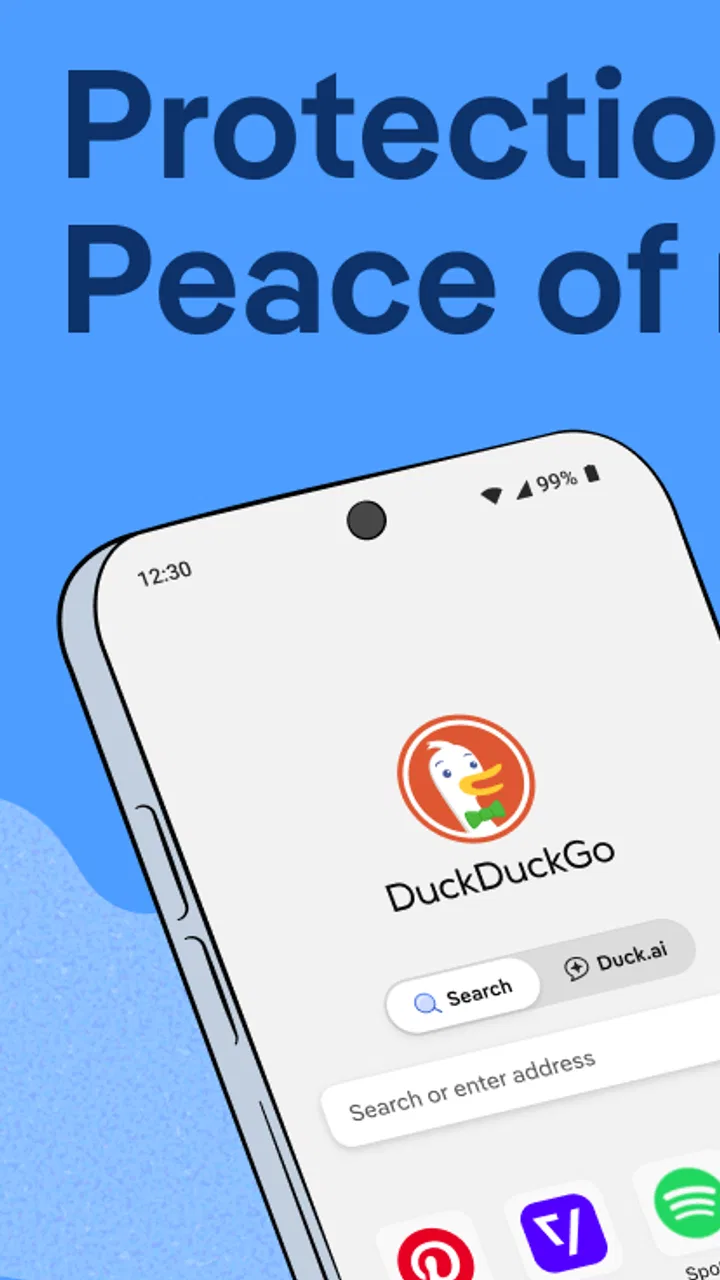
DuckDuckGo, optional Duck.ai
- 4.7
- Rating
- 50.00M
- Installs
- Free
- Price

 Analysis by App-foxy
I spent time with DuckDuckGo, Duck.ai, & VPN as a privacy-focused productivity app, paying particular attention to how comfortably it works in different situations and for people with different needs. The app brings private web search, browsing, ad blocking, optional AI tools, and VPN access into one place. That combination is useful, but it also means the experience can feel broader and busier than a simple search app.
What stood out to me first was the straightforward purpose. DuckDuckGo, developed by DuckDuckGo, is built for people who want to search and browse without making a conventional search engine the center of their online routine. I found it easy to understand at a basic level: open the app, enter a search, read the results, and move on. The more advanced privacy and subscription-related options take extra attention, though, so the app rewards users who are willing to explore its settings.
How the app handles readability and navigation
I found that readability begins with a familiar search field, but the app’s broader set of tools can add decisions once I move beyond basic browsing. In this section, I’d focus on keeping the screen routine simple and making choices deliberately, then consider how those choices feel with different motor and sensory needs.
You May Also Like

 Blood Strike: 2.5 Anniversary
Blood Strike’s Loadouts Turn Every Drop Into a Tactical Gamble
A close look at Blood Strike’s custom loadouts: how fast access to signature weapons reshapes its battle royale rhythm, rewards preparation, and narrows the gap between fights.

 Pandora - Music & Podcasts
Pandora’s Music Is Easy to Start, but Harder to Recover
Pandora’s strength is its low-effort path from a seed to a station. Its weak spot is how much confidence it asks you to place in connection, setup, and quiet recovery.

 8 Ball Pool
 Is Built on Rivalries, Rematches, and Routine
A close look at the rivalries, rematches, shared routines, and unanswered safety questions that turn a quick pool match into a persistent mobile community.

 Samsung Music
’s Quiet Strength Is Playing What You Already Own
Its reach comes less from spectacle than from dependable access to a personal library. That simplicity is both the app’s strongest retention engine and its ceiling.

 AccuWeather: Weather Radar
AccuWeather Review: A Quick, Clear Forecast for Everyday Decisions
For everyday plans, the best forecast is the one you can understand quickly. AccuWeather makes rain timing, radar, and local conditions easy to act on, with a few trade-offs.

 Hill Climb Racing
Why Hill Climb Racing Still Turns Crashes Into One More Run
A tiny car, a bumpy hill and one more upgrade: Hill Climb Racing keeps resurfacing because its simple chaos makes every near-miss feel personal.
More From Our News Desk
View All News


A familiar starting point for everyday searches
The main search experience is the easiest part to approach. The search field gives the app an obvious starting point, and the browser-style layout feels familiar if you have used mobile search before. I did not need to learn a complicated workflow to look something up, open a result, or return to the results page. That matters for anyone who prefers predictable navigation rather than a screen filled with competing controls.
For ordinary tasks such as checking opening information, comparing products, reading a news page, or looking up a definition, the app feels more focused than many privacy tools that bury their main function behind technical menus. I could use it casually without thinking about privacy settings every time. At the same time, the presence of browsing, AI, ad blocking, and VPN tools means the overall product is not as minimal as a dedicated search shortcut.
Where the extra tools add cognitive load
The optional AI area is a good example of the app’s two sides. It can be useful when I want help summarizing or shaping an idea instead of opening another service, but it introduces another decision: should I search normally, browse for a source, or ask the AI? For someone who prefers a single clear path, that choice can slow things down. I would treat Duck.ai as an optional assistant rather than the reason to install the whole app.
The same applies to the VPN. Having privacy-related tools in one product is convenient, but a user has to understand which protection is active during which activity. Search privacy, browser protections, and VPN coverage are not interchangeable concepts. The app makes the package approachable, yet users still need to read the explanations instead of assuming that every connection is protected in exactly the same way.
Reading comfort depends on the page being opened
Search results themselves are generally easier to scan than the web pages they lead to. Once I opened an external site, readability depended much more on that site’s design. A cluttered article, tiny text, aggressive pop-ups, or poor contrast can still create problems even when the search and browser controls feel manageable. The app’s ad-blocking capability can reduce some visual noise, but it cannot turn every badly designed page into an accessible one.
I also found that privacy prompts and feature explanations deserve a slower read. They are important because the product combines several functions, and rushing through them can lead to choices I do not fully understand. For users with dyslexia, attention difficulties, or limited patience for technical language, the best approach is to configure the app gradually rather than trying to understand every option during the first launch.
Useful habits for clearer navigation
My practical recommendation is to begin with one job: use the app for private search and browsing for a few days. After that, test ad blocking on the sites you visit most often, then decide whether the AI or VPN tools fit your routine. This staged approach avoids turning the first session into a settings project.
I would also keep the browser’s role clear in my mind. If I am researching a topic, I search, open a small number of results, and close pages that are no longer useful instead of leaving a crowded trail of tabs. That is not a special feature, but it makes a noticeable difference when navigating with a small screen, magnification, or a slower input method.
Motor and sensory considerations in real use
The same browsing flow can feel very different depending on touch comfort, vision, attention, and the pages being opened. I’d look at where short, deliberate interactions help and where longer sessions or intrusive page elements create extra effort, before turning to the settings and habits that can reduce that friction.
Good for short, deliberate interactions
For motor access, the app works best when I use it for short, intentional actions: tap the search field, type a phrase, choose a result, and read. This is a comfortable pattern for a phone because it does not demand constant gestures or rapid switching between several panels. Someone using one hand or relying on a slower touch response can take the process at their own pace.
Longer research sessions are more demanding. Opening multiple results, returning to search, moving between browser content and app controls, and checking privacy features can create more opportunities for accidental taps. I would not describe the experience as difficult, but I would be cautious about expecting it to replace a full desktop browser for complex research performed entirely on a small touchscreen.
Ad blocking can help sensory comfort, with exceptions
The ad-blocking function is one of the more practical features for sensory comfort. On pages overloaded with promotional elements, reducing visual interruptions can make reading less tiring. It can also make it easier to locate the actual article or form I came for. This is especially helpful when flashing banners, autoplay elements, or dense layouts make ordinary browsing uncomfortable.
There is a trade-off, however. Some websites depend on advertising or scripts for parts of their layout, video players, sign-in flows, or interactive tools. When a page behaves strangely, I may need to adjust the protection or use another browser for that task. A privacy feature is valuable only when it does not prevent me from completing the job, so I would keep an alternative available for websites that do not cooperate.
Audio, vision, and attention are different needs
People with low vision may appreciate a cleaner page when blocking removes distractions, but the final reading experience still depends on the website. People who use screen readers should judge the app together with their device’s built-in accessibility tools and the structure of the pages they open. I would avoid assuming that a private browser automatically makes every website accessible.
For users sensitive to motion or visual clutter, the simplest workflow is likely the best one: search directly, avoid unnecessary feature switching, and open only the pages needed. For users with attention-related difficulties, the optional AI can either reduce effort or add another tempting destination. I found it most useful when I had a clearly defined question, not as an endless place to explore.
Typing and voice input remain important
Search depends heavily on entering text, so the experience is partly shaped by the keyboard and input methods already available on the phone. If typing is painful or slow, voice input may make the app more practical, but that depends on the operating system and the user’s preferred tools rather than on DuckDuckGo alone. I would test a few realistic searches before deciding whether the app fits a hands-free or low-mobility routine.
A helpful workflow is to save frequently used destinations through the device’s normal shortcuts or keep a small list of recurring searches. That reduces repeated typing and makes the app more efficient for people who have limited dexterity. It also avoids the frustration of entering long, precise queries every time a familiar task comes up.
Situational access: where it fits best
A privacy browser is most useful when its workflow matches the place and task: a quick lookup on the move is not the same as research on a managed work device. I’d weigh those contexts against compatibility needs and the value of using only the tools relevant to the moment, then consider the trade-offs that remain.
Public Wi-Fi and travel
The privacy angle becomes more relevant when I am using a café network, hotel Wi-Fi, a library connection, or another shared network. The VPN option can be useful in those situations, especially for people who want an additional layer while moving between networks. I would still treat it as one part of safer online behavior rather than a reason to ignore account security or suspicious websites.
This is also where the app can serve users who do not want to install several separate privacy products. Search, browsing, ad blocking, and the optional VPN are available within the same broader experience. That convenience can reduce the number of apps a person has to learn, which is helpful for anyone managing limited storage, limited attention, or a complicated device setup.
A realistic everyday scenario
Imagine I am commuting, using a phone in bright daylight, and need to find a pharmacy, check a product detail, and read a short article before arriving. I can search privately, open the relevant pages, and benefit from fewer advertising distractions while moving between tasks. If I later connect to public Wi-Fi, I can consider the VPN option rather than switching to a completely different privacy app.
That scenario also shows the limits. Bright light, a moving vehicle, gloves, background noise, or one-handed use can make any mobile browser harder to operate. DuckDuckGo does not remove those physical challenges. Its value is that the basic search flow remains familiar and the privacy tools are close at hand, not that it solves every environmental problem.
School, work, and shared devices
For students, the app is useful when research privacy matters and the task involves ordinary web sources. It is less suitable as the only research tool if a school requires a particular search engine, institutional login, citation workflow, or browser extension. I would use it for independent searches, then verify important information through the original source rather than relying on a search snippet or AI response.
For work, it can be a sensible personal browser when I want to separate private browsing from a company-managed environment. It is not automatically the best choice for teams that depend on tightly integrated enterprise tools, shared browser profiles, or specialized web applications. In those cases, the usual workplace browser may be more compatible even if it offers fewer privacy-focused defaults.
When the AI option helps and when it does not
I found the optional AI most useful for low-risk tasks such as turning a rough question into a clearer starting point, organizing ideas, or helping me decide what to research next. I would not use it as the final authority for medical, legal, financial, or safety-critical decisions. The convenience of asking a question inside the app should not replace checking reliable primary sources.
Users who prefer direct control over sources may be happier with standard search and ordinary web pages. Users who struggle to phrase a search can find the AI a helpful bridge, but they should still inspect the underlying information. That distinction is important for inclusive use: assistance with wording can improve access, while uncritical trust can create new problems.
Remaining barriers and trade-offs
Even a thoughtfully arranged privacy app cannot guarantee that every website will behave well or that every user will find its options easy to interpret. I’d separate the practical barriers from the benefits and consider when keeping a second browser is the more dependable choice, leading into the final assessment.
The all-in-one design is not for everyone
The largest friction point is the product’s breadth. Someone looking only for a lightweight private search tool may feel that the AI, ad blocking, browser, and VPN options are more than necessary. Conversely, someone expecting a full replacement for a mainstream browser may find that certain websites work better elsewhere. The app is strongest for people who want a privacy-oriented starting point, not for users seeking every possible browser feature.
There are also financial considerations. The app is free to install, while in-app purchases range from around ten dollars to around one hundred dollars per item. That makes it important to check which optional services are relevant before committing to anything. I would begin with the free experience and only consider a paid feature if it solves a specific problem in my routine.
Compatibility can matter more than privacy preference
Some websites are built around scripts, advertising systems, embedded media, or browser behaviors that do not respond well to blocking. When a page fails, the solution may involve changing a protection setting, reopening it elsewhere, or accepting that the app is not the right tool for that task. This extra troubleshooting is a genuine accessibility issue for users who cannot easily switch between apps or interpret technical error messages.
The current version is 5.267.0 and the app supports devices running Android 8.0 or later. That makes the minimum system requirement clear for Android users, but practical comfort still depends on the phone, its display, input options, and the websites being visited. A supported operating system does not guarantee that every person will find the interface comfortable.
Privacy tools require informed choices
One subtle barrier is the risk of treating the word “private” as a complete promise about every part of online activity. I think the app does a good job of making privacy the central idea, but users still need to understand what they are doing when they search, open external pages, use AI, or activate a VPN. The safest experience is not the one with the most toggles; it is the one whose settings I actually understand.
That is why I would recommend a short personal checklist: identify whether I need private search, cleaner pages, protected network traffic, or help forming a question; enable only the relevant tool; and test important sites before depending on the setup. This reduces confusion and is especially useful for people who need a stable, repeatable workflow.
My inclusive verdict after using it
DuckDuckGo, Duck.ai, & VPN is a strong choice for people who want a more privacy-conscious way to search and browse without assembling several separate products. Its basic navigation is approachable, ad blocking can make busy pages easier to tolerate, and the optional AI and VPN tools give the app practical range. I also like that I can start with ordinary searches and explore the advanced parts only when they become relevant.
Its accessibility story is more nuanced than a simple claim that it works for everyone. The app supports a clear, familiar search routine, but the final experience depends on external websites, the phone’s input and display settings, and the user’s ability to understand several privacy-related choices. People with motor, sensory, or cognitive needs may find it comfortable in short sessions, while long research tasks and broken websites can introduce extra effort.
The app has earned a 4.7 average from around two million ratings and has passed over fifty million installs, which suggests that its approach has broad appeal. It is rated Everyone, and its long availability since April 8, 2011 gives it a mature place among mobile privacy tools. Those figures do not replace personal testing, but they do show that this is not a niche experiment.
I would recommend it to a friend who wants private search, a browser with fewer distractions, and optional privacy tools in one free app. I would suggest skipping it as a sole browser if work, school, or accessibility needs depend on specialized websites that frequently break under blocking. My bottom line is simple: start with private search, add features one at a time, and keep another browser available for compatibility.
Used that way, DuckDuckGo, Duck.ai, & VPN feels less like an all-or-nothing replacement and more like a practical privacy layer for everyday browsing. That balance is its real strength: it can make routine online tasks calmer and more deliberate, provided I remain aware of where its protections help and where the wider web still sets the limits.
FAQs for DuckDuckGo, optional Duck.ai
01What is DuckDuckGo, and how does it enhance privacy?
DuckDuckGo is a search engine designed to protect user privacy by not tracking search history or collecting personal information. Unlike traditional search engines, DuckDuckGo doesn't store IP addresses, ensuring searches remain private. This focus on privacy means users can browse the internet without the fear of being tracked or targeted with ads based on their search behavior.
02How does Duck.ai improve the search experience?
Duck.ai leverages artificial intelligence to provide more accurate and relevant search results. By using advanced algorithms, it can better understand user queries and deliver personalized results without compromising privacy. While maintaining user anonymity, Duck.ai enhances the search experience by quickly delivering precise answers and reducing the time spent sifting through irrelevant information.
03What are the main benefits of using a VPN with DuckDuckGo?
Using a VPN (Virtual Private Network) with DuckDuckGo adds an extra layer of security by encrypting internet traffic and masking the user's IP address. This combination ensures that online activities remain hidden from ISPs, hackers, and other third parties. A VPN also allows users to bypass geographical restrictions, accessing content from around the world while maintaining their privacy.
04Are there any limitations when using DuckDuckGo for searching?
While DuckDuckGo is excellent for privacy, it may not offer the same level of personalized search results as other search engines that track user data. This lack of personalization might result in less tailored search results. Additionally, DuckDuckGo's search index may not be as extensive as larger competitors, potentially affecting the breadth of results available for certain queries.
05Is DuckDuckGo compatible with all devices and platforms?
Yes, DuckDuckGo is compatible with all major devices and platforms, including Android, iOS, Windows, and macOS. Users can access DuckDuckGo through a web browser or download dedicated apps for mobile devices. This versatility ensures that users can maintain their privacy across different devices, whether they're on a smartphone, tablet, or computer.
Pros
- Enhanced privacy with no tracking.
- Simple and clean user interface.
- Fast browsing experience.
- Built-in ad blocker feature.
- Free and easy to set up.
Cons
- Limited advanced settings options.
- Occasional website compatibility issues.
- No real-time traffic data.
- Doesn't allow extensions.
- Limited customization for appearance.

DuckDuckGo, optional Duck.ai
Gallery